
Walking.
Through countryside and history.

After a January of mostly grey skies, although not much rain, we woke today to sunshine. The clear night had brought a fairly heavy frost, but it was too good a day to worry about that. With a forecast high of 6C, and little wind, it was a day for a long walk.
We chose a 12 km ‘circular’ walk (it’s more of a rhombus) through agricultural land north of Great Bircham. A mix of track and footpath, with the absolute minimum – less than 500 m, I estimate – of paved road, it’s one of my favourite walks, but it demands a day of blue skies to properly appreciate the long views and to definitively identify some of the birds.
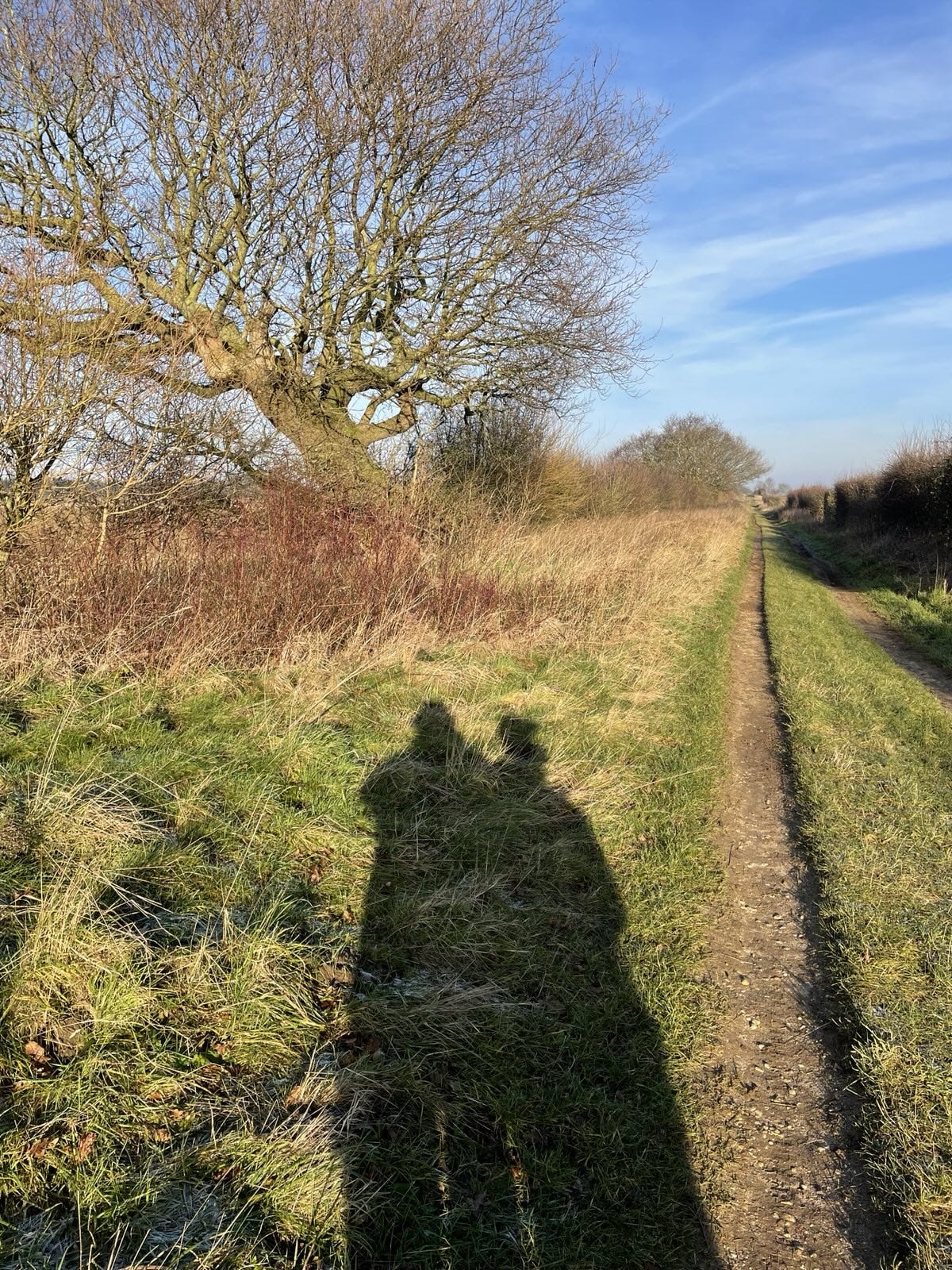
Frost still lay on the track when we began, in any place where the hedges still blocked the low morning sun. Skims of ice covered puddles. But the sun was shining, so the skylarks were singing. Yellowhammers flew in and out of the hedges, along with great and blue tits, robins and dunnocks.
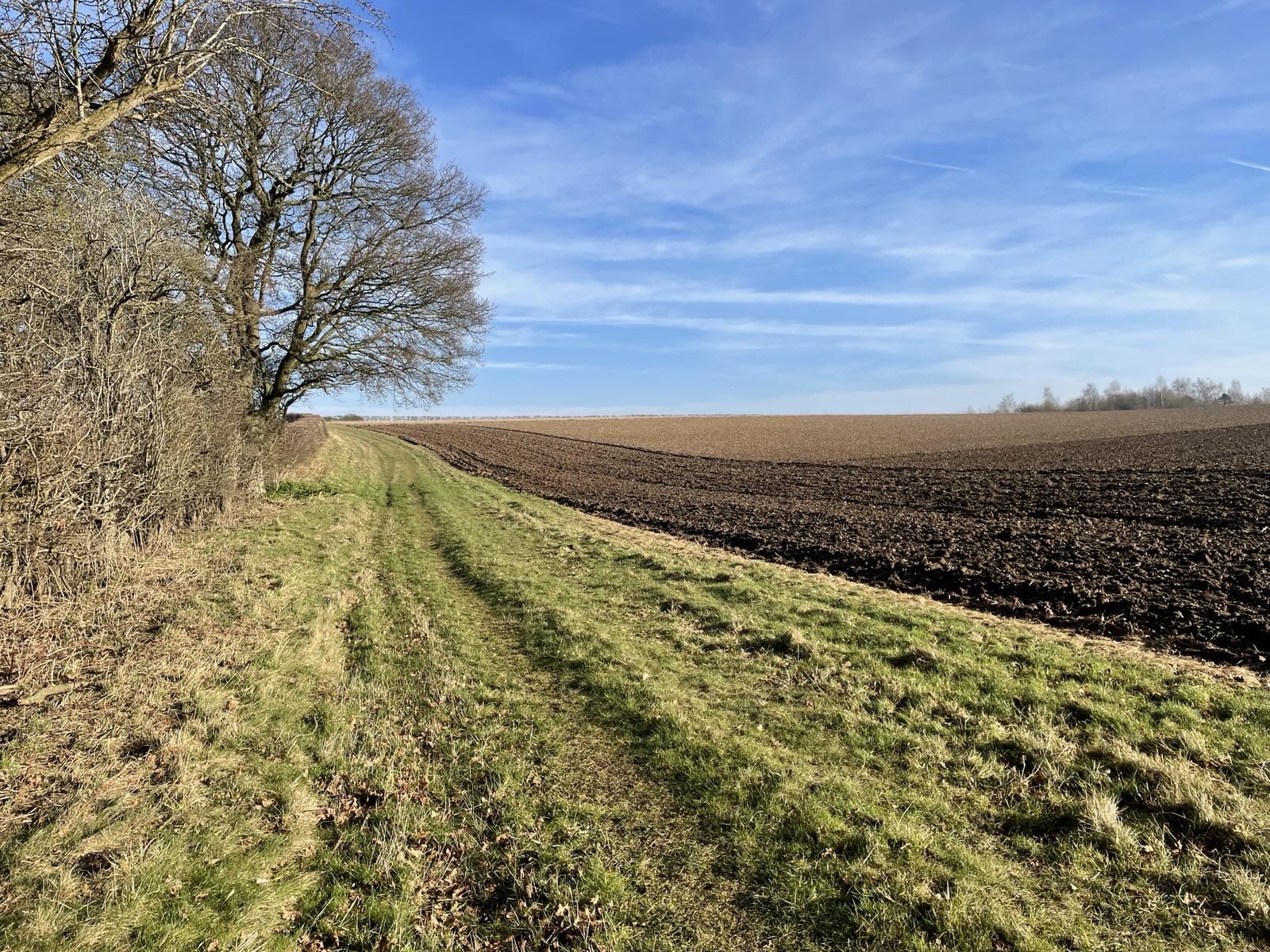
The walk begins on a section of the Peddar’s Way, the Roman road that runs across Norfolk from Knettishall Heath in Suffolk to Holme-next-the-Sea on the north coast. Arable farmland lies on either side, much planted to winter crops, some newly-ploughed, some stubble. Gulls – black-headed and common, a few corvids, and a biomass of woodpigeons that could feed a town, investigated the cultivated fields.
We turned north-east, along a track lined on both sides with hedges, broken by stag-horned oaks. A coal tit forages in one. Frost still sparkles on the plants and fallen leaves we’re walking on, except where a gap in the hedge has let sunlight through. In a stubble field, half a dozen Chinese water deer are resting; they look at us with their soft-toy faces, decide discretion is required, and lope away. All female or immature males: none have the curving tusks of a mature male.
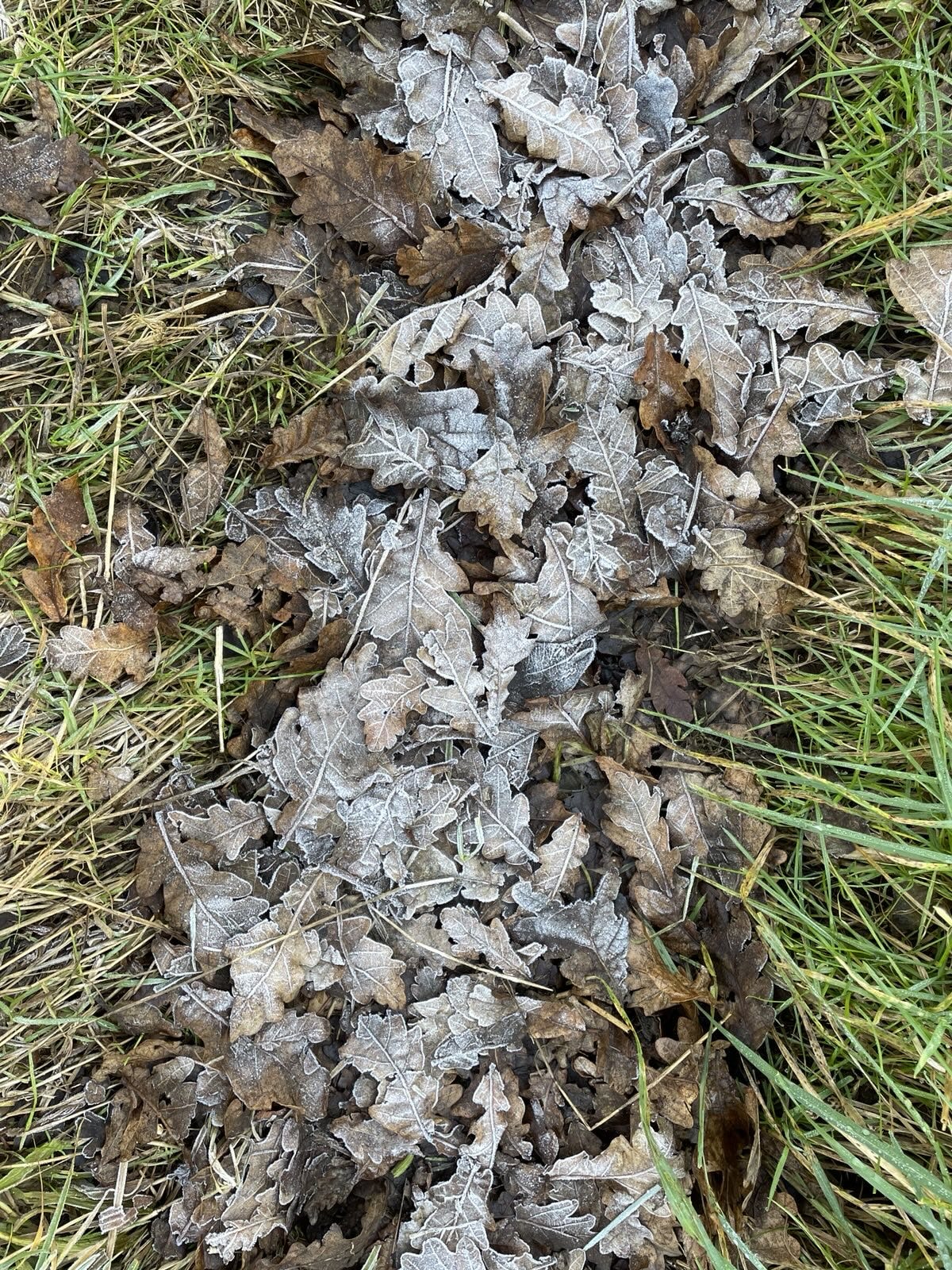
Chaffinches sing from the hedgetops, and blackbirds rustle. The blackbirds are all male, and many are visitors from further north in the UK or Europe. The females are mostly in southern Europe, where the living is easier. A hare – and then a second – break from their forms in the winter cereal crop beside us and race over the field, stopping to look back for a few seconds, then racing off again.
The track ends at a lane but continues on the other side as a footpath, gently climbing up to higher ground. Overhead buzzards circle, and a kestrel hovers: the small mammal population here must be healthy. I take of my scarf and squash it into a pocket of my jacket, but keep my gloves on.
A bit further on we investigate a pond in a small woodland, fed by a fast-flowing stream. Only mallards inhabit it. The males quack their indignation at being disturbed, and we leave them in peace. A footpath we’ve never walked runs northwest from the pond, an exploration for another day.
The track comes out in the hamlet of Bircham Newton, and the first 100 m of pavement until we cross the B1153 and return to farm track. A cat, rodent in mouth, runs across the track in front of us. At the point at which we turn right again, two massive concrete gate posts stand – minus a gate. I’ve wondered about them in the past, but today, checking the ordnance survey map on my phone, I realize that the track continues on into what was RAF Bircham Newton. At a guess, the gates marked the limits of the airfield’s property at one time.
The next section isn’t well used, the path broken by molehills and snaked with brambles that try to trip me. But it’s only a short section, and its minor difficulty rewards us with a sparrowhawk. We startled the bird, and in its flight away from us it drops the prey – a vole or similar mammal – it held in its talons. Further away, a red kite surveys for carrion; maybe it will find the vole.
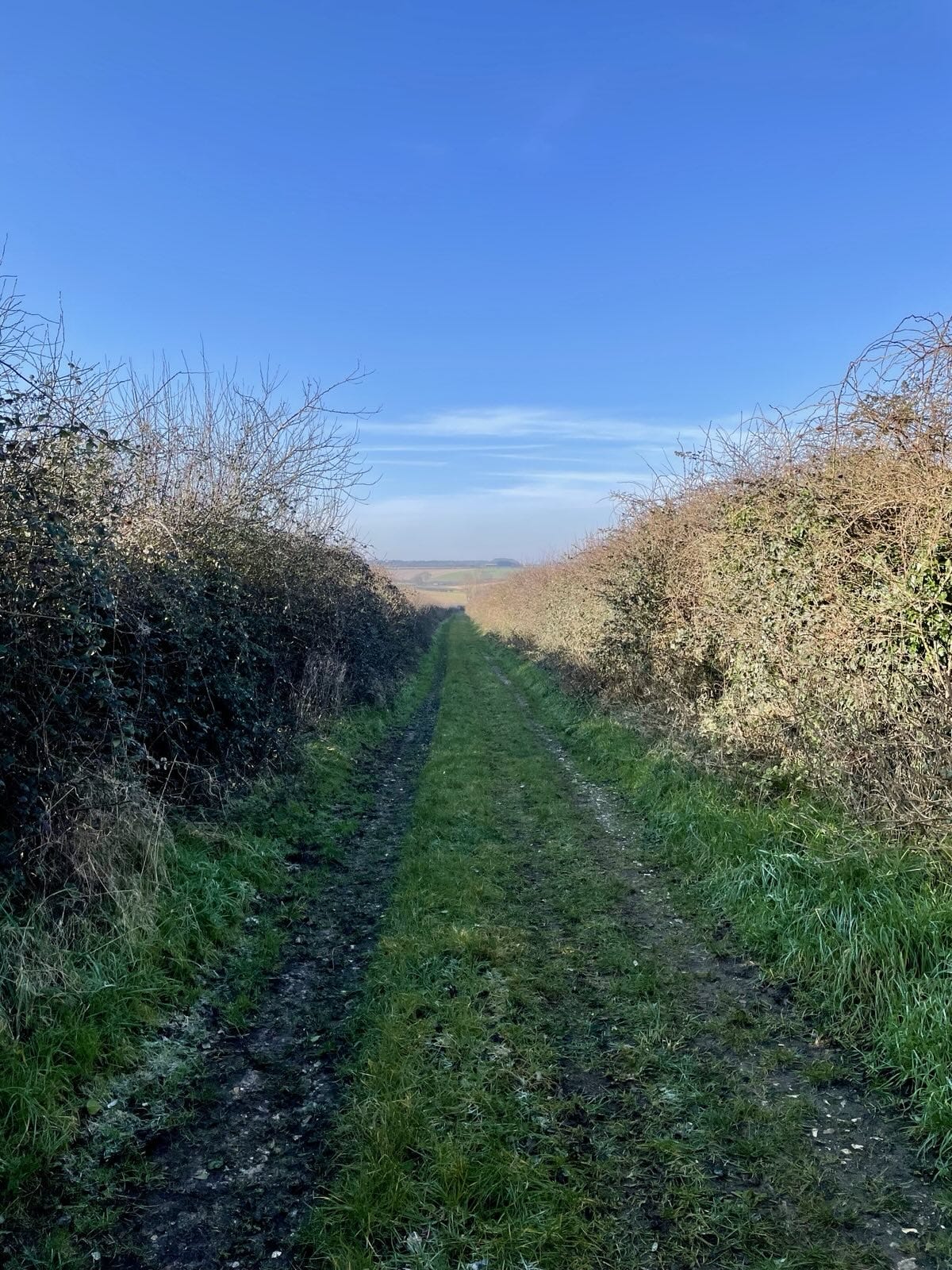
At another junction of tracks stands a tall oak, and at its very top, a song thrush, the first of the year for us. In the ivy-thick hedges of this next section, berries are plentiful, but not berry-eaters, except blackbirds; we’ve seen few redwings this winter, usually mixed in with fieldfare on winter cereal fields. A pheasant or two – survivors of the shooting season, which ended February 1st – wander along the edges of fields. No red-legged partridge, also a bird raised for the shoots, on this walk, and no greys, either.
The track bring us to Bircham Tofts, beside the duck pond, which is full of domestic ducks and a few white geese. I sit to try to find the tiny pebble in my right boot, with no luck. In the distance beyond the pond stand the ruins of St Andrew’s church, its square tower smothered in ivy. According to Simon Knott1: “The church was in regular use until the Second World War, but proximity to Bircham airfield placed it off limits. It was never restored to use, being less than a mile from St Mary in the middle of the village. St Andrew was abandoned in the late 1940s, unroofed in 1952, and in the sixty-odd years since has almost completely gone back to nature.” Some of the surviving walls may date to the 13th century, with 15th elements; there is also evidence, apparently, of a 19th C restoration. 2
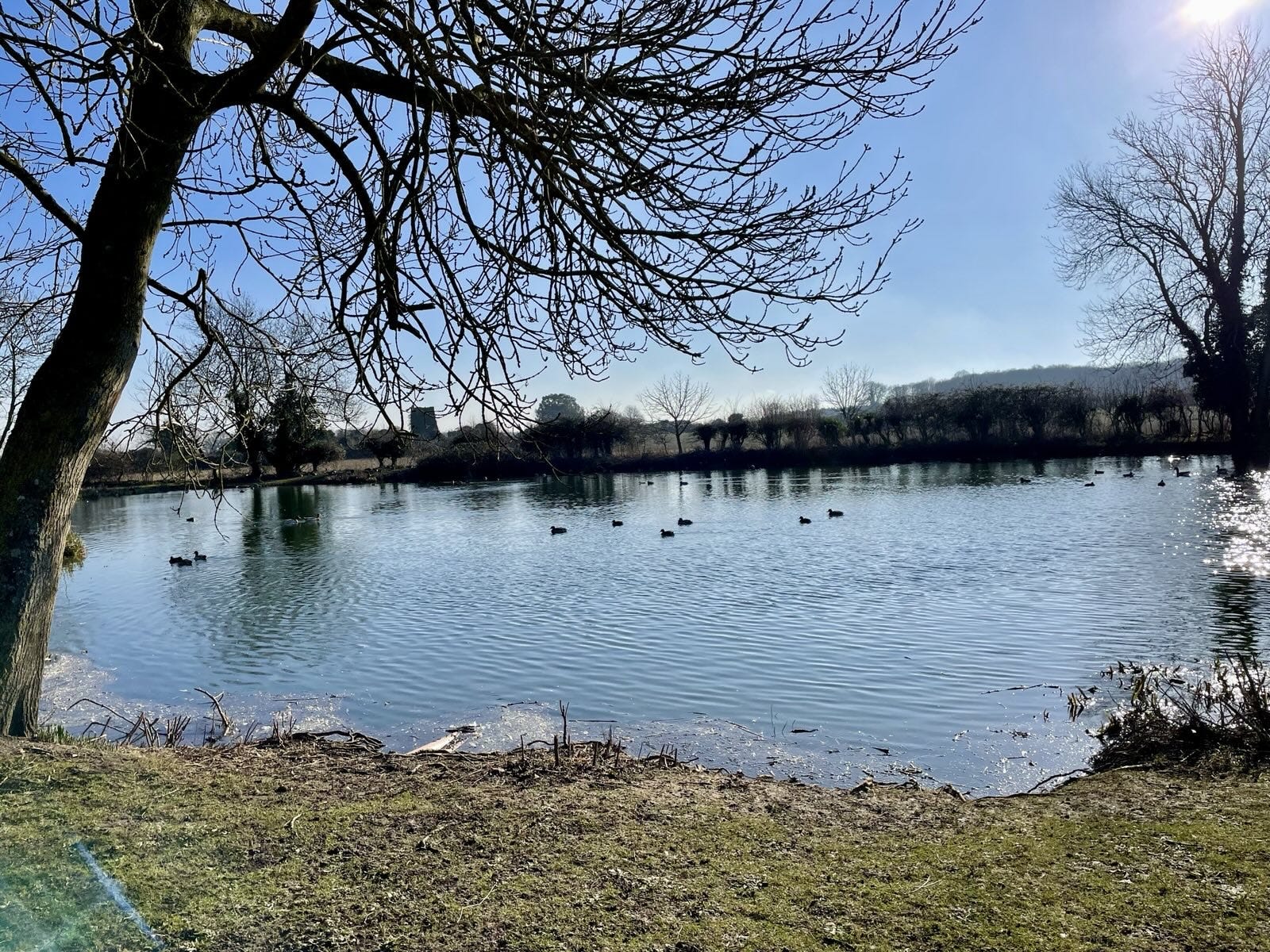
By now we’ve been walking about three hours. Ahead of us is the village of Great Bircham, which has an excellent deli-café – but it’s 11:40 and the place closes at 12:00. We make it with a few minutes to spare, and have a restoring snack (cheese scone for me, brownie for Brian) and drinks before emptying my right boot again, this time finding the tiny shard of flint, then heading out for the last four kilometers of the walk.
I’m sweating, so I decide to walk with bare hands and unzipped jacket. Lots of outdoor pigs in the adjoining fields, and with them pied wagtails. A bit further along (we’re back on the Peddar’s Way now) a large puddle in the field parallels the track. I’m looking at a muntjac on the field opposite when Brian calls, ‘green sandpiper!’ I missed it, but that’s birding.
Back at the car, after a little under four hours. Muddy boots are changed for shoes, the boots go in their bootbags, jackets are shed, and we head for home and lunch. We’ve walked through beautiful countryside, but also through history: the Roman road that follows the line of an older track; the Old Norse element in the name of Bircham Tofts, a ‘toft’ being a homestead. In the Domesday Book, Bircham is Brecham, newly-occupied ground, suggesting that the first settlement here was likely late Saxon. We passed at three medieval churches, two still in use, one in ruins. The working windmill in Great Bircham is Victorian, replacing an earlier, 18th C grain mill; the village’s gracious public house is Edwardian. RAF Bircham Newton was in use from 1918 to 1962.
And for all that time, there would have been yellowhammers and kestrels and dunnocks, and the high, endless song of skylarks.
Pictures are a thousand words. They are very good. The words are the substance that makes you feel like you’re on the walk, while you are doing armchair travelling. This was so captivating and inspiring to read. Loved it!!! Thank you very much for sharing your travels.
I love the way we can time travel walking in the UK